Where swings once traced circles in the air,
only dust now rises.
Yet even in silence, children wait for us to answer:
will we teach them only how to endure,
or how to live again with laughter?
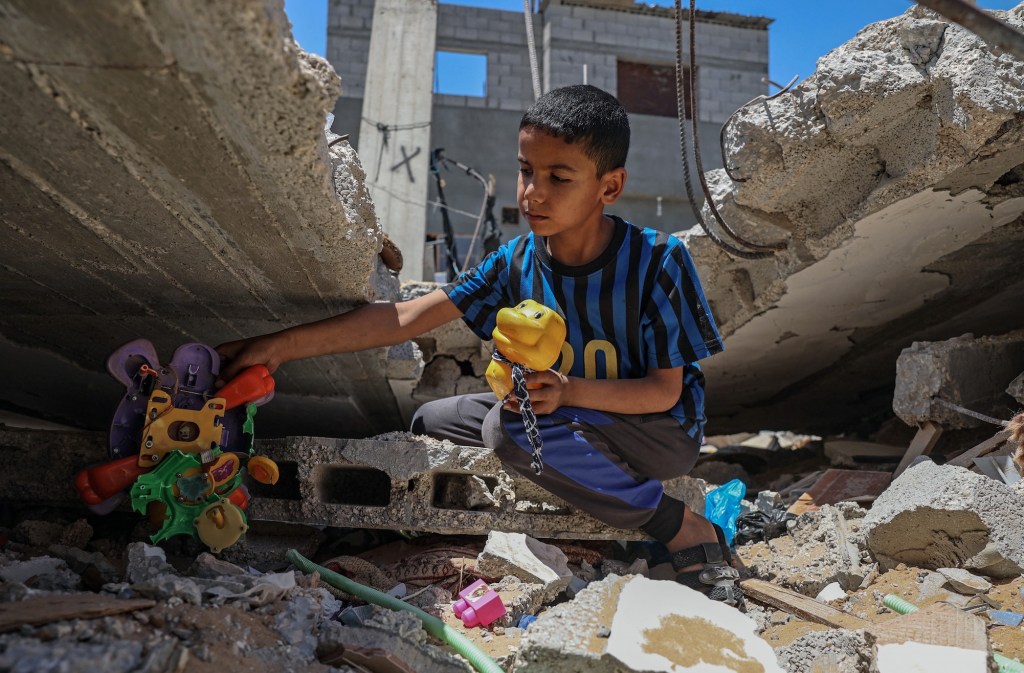
A Palestinian boy recovers toys from the rubble in Khan Yunis on 26 May 2021 following Israeli air strikes (AFP/Said Khatib)
The Lessons of War
Psychologists remind us that children build their moral world by watching adults. When violence dominates, compassion looks naïve. When suffering is ignored, indifference becomes wisdom. Every bomb, every burial, becomes a curriculum — teaching not resilience, but endurance without relief.
The brain learns by repetition. Repeated fear wires hypervigilance. Repeated loss erodes trust. Over time, survival replaces imagination. A childhood under siege is not defined by curiosity but by caution.
And silence becomes another teacher. Parents weep quietly, afraid that words will break the fragile barrier between holding on and collapse. Children learn that grief has no audience. A child who stops crying is not healed; they are exhausted.
Normalizing the Unthinkable
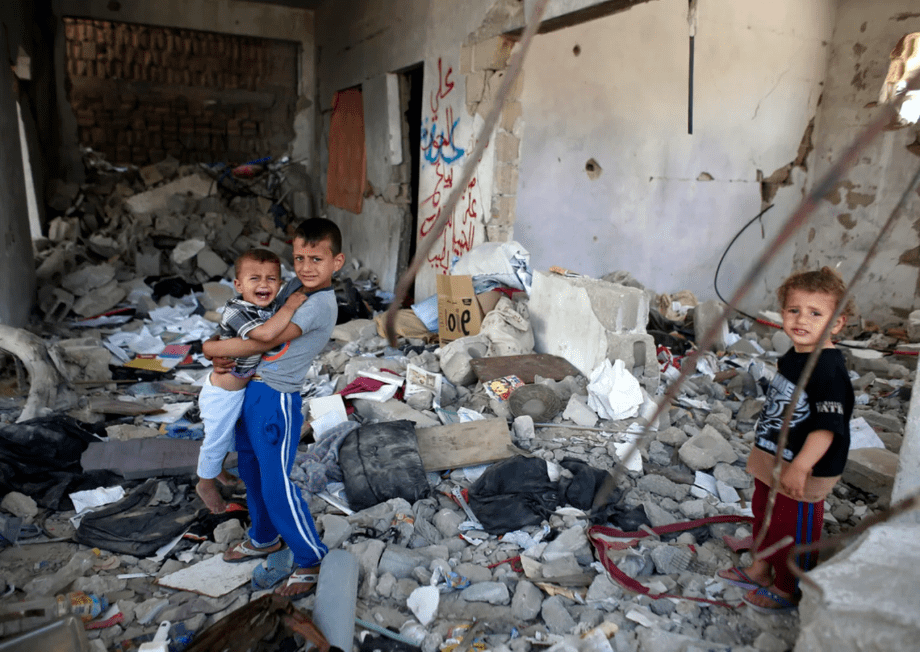
Gaza’s children now distinguish between the “near” explosion and the “far” one. They know the direction of drones by sound. Death has become part of the week. This is not cultural adaptation — it is neurological conditioning.
And the dulling of empathy spreads beyond Gaza. As the world scrolls past images of wounded children, we too normalize the unthinkable. Pain, repeated enough, stops being news.
Moral Confusion
Conflict collapses moral language. Words like freedom and justice shift meaning depending on who speaks them. Children hear cruelty justified as necessity. They see leaders speak of peace while funding
This inconsistency breeds moral disorientation — a world where right and wrong blur, and truth itself becomes negotiable.

A Palestinian child attends hospital in Gaza on October 13.
Saher Alghorra/Middle East Images/AFP/Getty Images
Beyond Gaza: The Global Lesson
And what of the children beyond Gaza, those watching from afar? They learn that empathy can be optional, that distance excuses inaction. They learn that suffering is an event, not an emergency. We are raising witnesses who mistake awareness for accountability.
Every child, everywhere, is watching how we respond. They are learning whether humanity is conditional — whether where you are born determines whose pain matters.
The Educational Ruin
The damage is not only emotional but educational. Schools in Gaza lie in ruins or serve as shelters. Without continuity of learning, memory falters, curiosity contracts. Survival replaces creativity. The future itself becomes unimaginable.
What we have not taught them — or rather, what we have failed to teach — is that the world cares enough to repair this. Trauma untreated becomes transmitted. Bosnia, Rwanda, Syria have shown us this pattern. Gaza is different only in that the trauma is televised in real time — and still allowed to continue.
What Must Be Taught
Rebuilding Gaza’s children cannot be left to hope. Trauma recovery must be structured, funded, professional. Every new classroom should also be a counseling center. Every teacher trained in trauma awareness. Every reconstruction plan must begin with the human mind, not the concrete wall.
But beyond therapy lies the deeper work of meaning. Children must relearn that kindness is not weakness, that empathy is possible without pain, that humanity exists beyond survival. They need stories, art, and connection — reminders that their lives are not defined by violence.
And for the rest of us, moral repair begins with honesty. Neutrality is not virtue. Silence in the face of repeated suffering is not balance; it is consent. When we fail to protect children, we teach them that protection is a privilege, not a right. When we fail to hold leaders accountable, we teach them that power excuses harm.
The Measure of Civilization
Yet there is still something we can teach. That healing is possible when compassion is structured. That empathy can be practiced as policy. That humanity, though slow to awaken, has not disappeared.
If one day, a child in Gaza can laugh again without flinching, that will be the true measure of our civilization.
Not how we fought, but how we repaired.
Not what we destroyed, but what we chose to teach.
 NightingaleSea
Leave a comment