China’s military parade is not a spectacle—it’s a statement. Every missile, drone, and marching formation is chosen to signal strategic intent. Beneath the synchronized movements lies a doctrine of deterrence, denial, and technological ambition. This is not improvisation. It’s execution of a long-term plan to reshape the regional security landscape.
China’s military parades are not mere spectacles. They are strategic performances—choreographed to signal capability, resolve, and ambition. Every missile, drone, and marching formation is a message. To domestic audiences, it’s pride and legitimacy. To foreign observers, it’s deterrence wrapped in precision.
This year’s parade was no exception. It offered a curated glimpse into Beijing’s defense mindset:
one rooted in denial, deterrence, and deliberate shaping of the strategic environment.
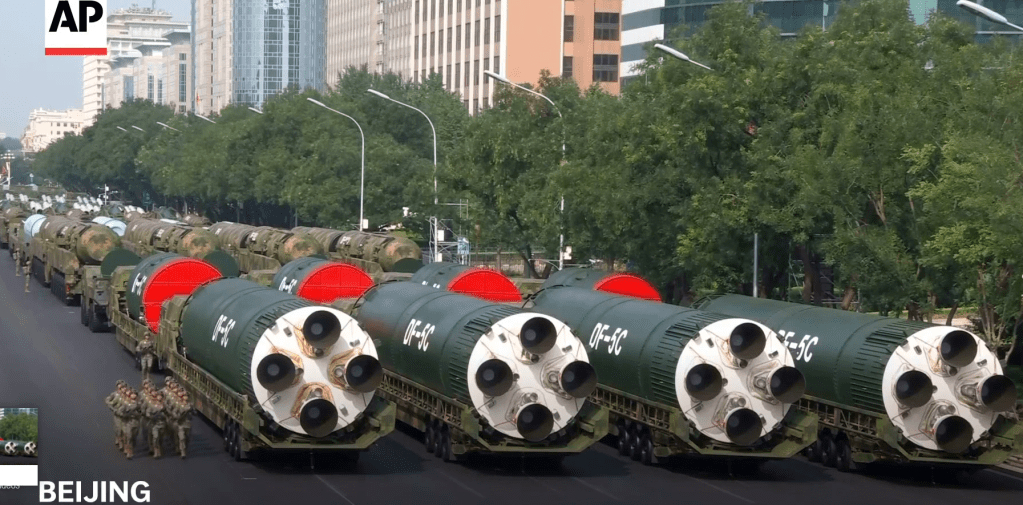
Missiles That Speak Louder Than Diplomats
Front and center were China’s long-range precision strike systems. The DF-41 intercontinental ballistic missile, capable of reaching the U.S. mainland, stood tall as a symbol of nuclear credibility. Alongside it, the DF-26—dubbed the “Guam killer”—underscored China’s ability to hold U.S. bases in the Western Pacific at risk.
This isn’t just hardware—it’s doctrine. Beijing’s emphasis on missile systems reflects a counter-intervention mindset: a warning to outside powers, especially the United States, that interference in regional conflicts like Taiwan will come at a steep cost.
“When missiles get more airtime than ministers, you know the parade isn’t just for show—it’s a message in motion.”
Walls Without Borders: China’s A2/AD Strategy
From anti-ship ballistic missiles to advanced surface-to-air batteries, the parade showcased China’s growing anti-access/area denial (A2/AD) capabilities. These systems are designed not for global projection, but for regional control—creating bubbles of denial around China’s periphery.
This aligns with the PLA’s doctrine of “active defense”: asserting sovereignty by denying adversaries the operational space to intervene. The message is clear—China prioritizes dominance near its shores, not distant adventures.
From Import to Innovation: The Tech Leap
Gone are the days of imported Russian tech. Today’s parade spotlighted unmanned systems, hypersonic platforms, and space assets born from China’s own innovation pipeline. The subtext? Self-sufficiency and ambition.
China isn’t just catching up—it’s leapfrogging. In domains like hypersonics and drones, the PLA is signaling that it can produce cutting-edge systems at scale. The defense mindset is no longer reactive—it’s competitive.
The Parade as Psychological Warfare
Military parades are also psychological operations. Hundreds of platforms moving in perfect formation project discipline, modernity, and inevitability. Internally, it’s a celebration of national rejuvenation. Externally, it’s a warning: China is unified, modernized, and prepared.
This dual signaling reinforces the Communist Party’s authority while shaping global perceptions. Military power, in this context, is as much about narrative as it is about combat.
Airpower and Strategic Reach
The unveiling of stealth aircraft like the J-20 and long-range bombers points to ambitions beyond coastal defense. These platforms suggest a growing intent to project power deeper into the Pacific—and eventually, into the Indian Ocean.
While China is not yet a global expeditionary force, the trajectory is unmistakable: sustained presence in key maritime zones that underpin trade and security.
Maritime Might: The Naval Narrative
Though not all naval assets roll across parade grounds, their presence is felt. New destroyers, aircraft carriers, and submarines are increasingly referenced in fleet reviews and parade commentary.
The intent? To secure the South China Sea, protect maritime approaches, and challenge the era of uncontested naval dominance. China’s maritime domain is now the core theater of future rivalry.
Space and Cyber: The Invisible Frontlines
Recent parades have nodded to space and cyber capabilities—satellite launch vehicles, counter-space systems, and electronic warfare units. These additions reflect a multi-domain mindset: future wars will be won not just by firepower, but by information dominance.
Beijing understands that control of surveillance, denial of adversary systems, and cyber resilience are now central to strategic success.
Two Audiences, One Message
China’s parade speaks to two audiences. Domestically, it legitimizes the Communist Party as the architect of national strength. Internationally, it’s theater of deterrence—designed to alter adversary calculations without firing a shot.
It’s a performance of power, meant to reassure allies, unsettle rivals, and reinforce the narrative of China’s rise.
Continuity Over Surprise
The systems on display confirm long-standing trends: counter-intervention strategy, Taiwan contingency planning, denial over projection, and a shift toward intelligentized warfare.
This is not improvisation. It’s execution of a long-term plan. The parade is less about novelty and more about reaffirming doctrine.
Strategic Shaping, Not Conquest
Ultimately, the parade’s message is not one of conquest—it’s strategic shaping. China seeks to build a military so capable that adversaries hesitate before acting. Deterrence through strength, not adventurism abroad.
Yet the duality remains: the same systems that defend can also coerce. This tension is central to Beijing’s posture.
Final Reflection: Beyond the March
China’s military parade is more than a march—it’s a manifesto. It reveals a defense mindset focused on sovereignty, denial, and multi-domain dominance. It signals confidence in indigenous tech, ambition in air and maritime reach, and awareness of the invisible battles in space and cyber.
As the PLA evolves, so too does the strategic environment. And for those watching from afar—whether with popcorn or policy memos—the message is unmistakable: China is shaping the future, one formation at a time.
“China’s parade wasn’t just a march—it was a manifesto. The question isn’t whether the world is watching. It’s whether it understands what it’s seeing.”
Strategic References & Further Reading
Because behind every parade is a doctrine—and behind every doctrine, a story worth decoding.
U.S. Army War College – Strategic Studies Institute
Title: China’s September 2025 Military Parade: How PLA Ground Forces Are Adapting to Future Warfare
Summary: A doctrinal deep dive into PLA modernization, with emphasis on land-based firepower, hypersonic systems, and the parade’s role in shaping future conflict expectations.
🔗 Read the full study
NewsBharati – Strategic Implications of China’s Parade
Title: China Military Parade: Analyzing Strategic Implications
Summary: A regional lens on the parade’s messaging, with insights into India, Taiwan, and the symbolism of authoritarian unity.
🔗 Explore the analysis
ChinaStrategy.org – Geopolitical Messaging and Military Reveals
Title: Military Reveals and Bold Messaging: Five Key Takeaways from China’s Big Parade
Summary: A concise breakdown of psychological signaling, stealth aircraft reveals, and strategic intent across maritime and cyber domains.
🔗 View the key takeaways
 NightingaleSea
Leave a comment