How a Global Anthem Faded in an Era of Self and Nation First
The Night the World Sang in One Key
Forty years ago, a soundwave of unprecedented unity swept across the globe. From the crackle of a transistor radio in Manila to the speakers of a family television in Cairo, the message was clear and simple: “We are the world, we are the children.”
Released in 1985, We Are the World was more than a charity single—it was a cultural phenomenon. A moment when the world, however fleetingly, seemed to come together as one.
From Chorus to Echo Chamber
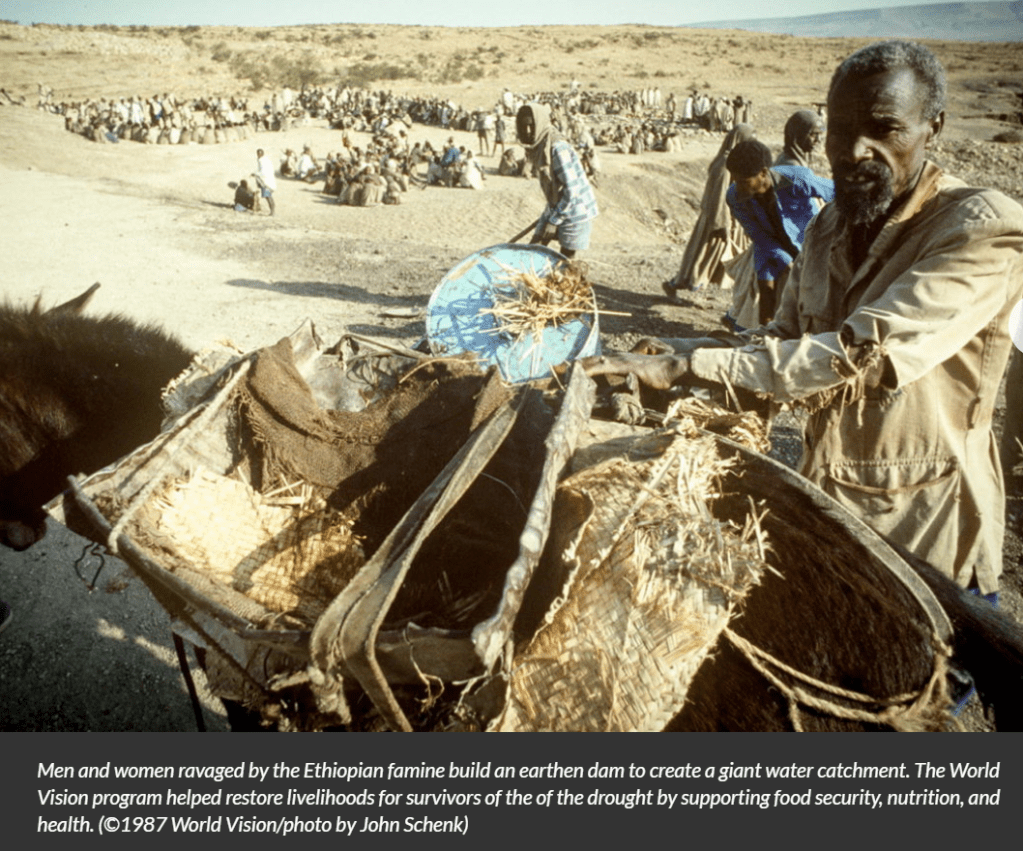
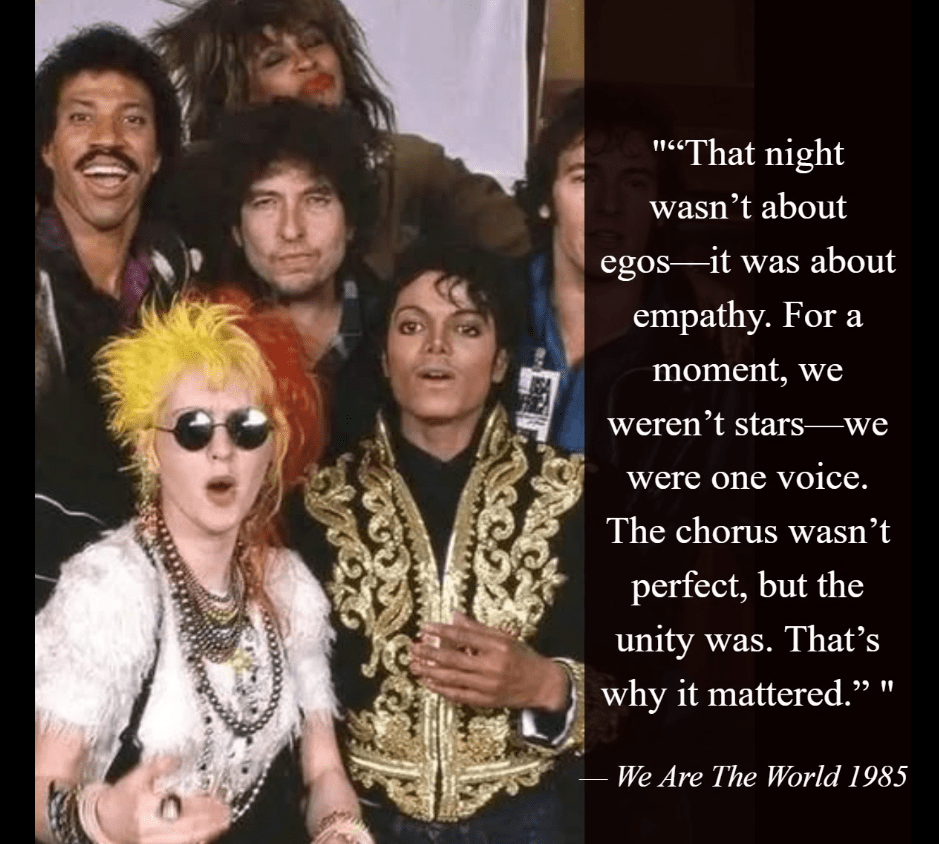
Today, on August 11, 2025, the song lives on in 80s nostalgia playlists. We remember the star-studded lineup—Michael Jackson’s sequined glove, Bob Dylan’s unmistakable rasp, Cyndi Lauper’s vibrant energy. We remember the cause: famine relief for Ethiopia.
But in a world increasingly dominated by curated individualism and fortified borders, we seem to have forgotten its essence. The powerful call to collective action has been drowned out by two modern mantras: “Me first” and “My nation first.”
The Algorithm Doesn’t Sing
“Have you Play the song. Sit with one line. What does lending a hand mean to you today?”
The song’s plea—“it’s time to lend a hand to life”—feels profoundly at odds with the spirit of our age.
The 21st century has crowned the individual as a brand. Social media, while connecting us in theory, has built digital echo chambers in practice. Our feeds reflect our own interests, solidify our biases, and shrink our worldview.
“Lending a hand” has been reduced to a performative hashtag, a temporary profile frame, or a ‘like’ on a tragic story before we scroll to the next piece of content.
We are still pretending, as the lyrics warned, “that someone, somewhere will soon make a change.”
Only now, our Pretence is cushioned by the illusion of curated reality—where the world’s most pressing problems can be silenced with a swipe.
#LendARealHand
Flags Don’t Stop Fires
This inward focus is mirrored on a grander scale: the resurgence of hardline nationalism.
The song’s core belief—“we are all a part of God’s great big family”—has been challenged by exclusionary policies, trade wars, and a retreat from global cooperation.
“What does it mean to be part of one family in a divided world?”
The very crises that demand a We Are the World spirit—climate change, refugee emergencies, and the memory of vaccine hoarding—have been met with the opposite: raised drawbridges.
Twisting the Lyric
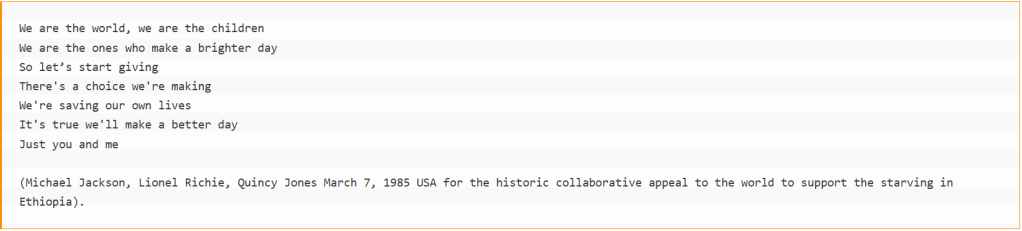
“There’s a choice we’re making, we’re saving our own lives”
was meant to affirm shared destiny. That in saving others, we save our collective humanity.
Today, that line has been twisted into a justification for national survivalism.
It’s no longer about saving “our own lives” as a global community, but saving lives within borders—often at the expense of others.
The world is no longer a single entity to be nurtured, but a competitive arena.
And yet, fires, floods, and viruses do not recognize flags.
The Anthem Didn’t Fail—We Did
So, has the anthem failed?
Perhaps not.
Its message hasn’t become irrelevant—we’ve simply become poor listeners.
Its idealism is a benchmark against which we can measure our current reality.
It reminds us that global cooperation is not a naive dream, but a tangible achievement once realized, broadcast, and celebrated.
Press Play Again
Forty years on, the song stands as a ghost of a more hopeful past.
A poignant reminder of a time when the world’s biggest stars believed—and made us believe—that a better day was possible if we just acted as one.
It begs the question:
What would it take to create such a moment of global unity today?
In an age of deep division, perhaps the first step is to simply listen to the old song again.
And ask ourselves honestly:
Is the world it describes one we’re willing to let go of forever?
The Choice Is Ours to Make
Let the chorus echo again—not just in memory, but in action.
Not just in playlists, but in practice.
Listen. Then choose.
#PerformativeActivism
#DigitalEchoChamber
#NationalismVsGlobalism
#SocialMediaActivism
#HumanityFirst
#UnityNotDivision
 NightingaleSea
Leave a comment