Once, not so long ago—though it now feels like another lifetime—a rhyme gently danced across the lips of children around the world:
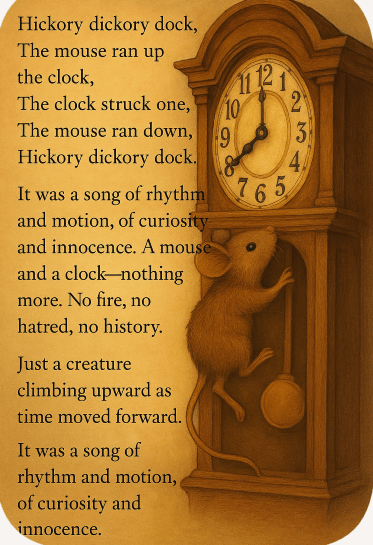
A mouse and a clock—nothing more. No fire, no hatred, no history. Just a creature climbing upward as time moved forward. The author of this rhyme, anonymous and long gone, could not have imagined that centuries later, the ticking of the clock would sound more like a countdown to catastrophe than a child’s lullaby.|
Today, clocks strike with urgency in a region trembling under the weight of decades-old hostilities. Israel, already entrenched in a brutal campaign in Gaza, now faces escalating clashes on multiple fronts.
On April 13, 2024, the world watched in stunned silence as Iran launched over 300 drones and missiles toward Israeli territory—the first direct assault from Tehran since the Islamic Revolution. Though most were intercepted by Israel’s multi-layered air defenses and aided by American, British, and Jordanian forces, the message was clear: the rules of engagement had changed.
The mouse has run up the clock—and this time, it carries the burden of war.
In Gaza, the devastation is nearly beyond comprehension. Entire neighborhoods flattened. Children pulled from rubble. More than 37,000 Palestinians reportedly dead, according to local health officials, with civilian infrastructure in ruins. UN schools have become shelters. Hospitals run on fumes. Food and water are scarce. Yet the fighting continues.
Meanwhile, in Israel’s northern towns, residents huddle in bomb shelters as Hezbollah rockets rain down from southern Lebanon.
Homes in Kiryat Shmona lie scorched and abandoned. Over 100,000 Israelis have been displaced from the northern and southern borders.
In one widely broadcast scene, a father in Sderot carries his toddler through shattered glass and burning cars, whispering words not unlike a lullaby—anything to keep the child from crying.
What would the author of Hickory Dickory Dock think of this world?
Would they recognize the mouse as a symbol of fragile innocence—now trapped in a maze of geopolitical fury, darting between airstrikes and algorithms, between TikTok trends and Tikrit drone footage? Would they see the clock not as a keeper of time, but as a doomsday device—ticking toward another regional war that could draw in the U.S., Hezbollah, Iran, and perhaps worse?
The mouse ran up the clock.
We, too, have ascended—climbing in power, technology, and speed—but we’ve forgotten how to climb down. The clock has struck more than one. It has struck Beirut, Tel Aviv, Damascus, and Isfahan. It has struck homes and hospitals, faith and reason. It has struck every chord that once held the fragile harmony of the Middle East together.
Still, somewhere, perhaps in the eye of a storm or under the ash of a collapsed building, a child may hum that same nursery rhyme. A mother, despite everything, may whisper it into her baby’s ear while cradling them beneath rubble or within a tent lit only by candlelight. The song survives—because hope, in its quietest form, resists even in war.
Hickory dickory dock.
The mouse ran up the clock.
The bombs fell down,
Across the town,
Hickory dickory… stop?
If only.
But the clock keeps ticking. And the world watches, waiting to see if the mouse runs down again—or disappears entirely in the fire and smoke of our own making.
TIK TOK TIK TOK.
 NightingaleSea
Leave a comment