Understanding the Significance of the First China-Indonesia 2+2 Dialogue
On April 21, 2025, China and Indonesia held their first-ever 2+2 ministerial dialogue, bringing together the foreign and defense ministers of both nations in Beijing. This was not merely a diplomatic formality—it marked a pivotal evolution in the relationship between two of Asia’s most influential countries. Notably, this was the first time China had engaged in such a ministerial format with any country, underscoring Beijing’s deliberate effort to deepen ties with Jakarta. The timing was symbolic, coinciding with 75 years of diplomatic relations, reaffirming Indonesia’s high strategic value to China.
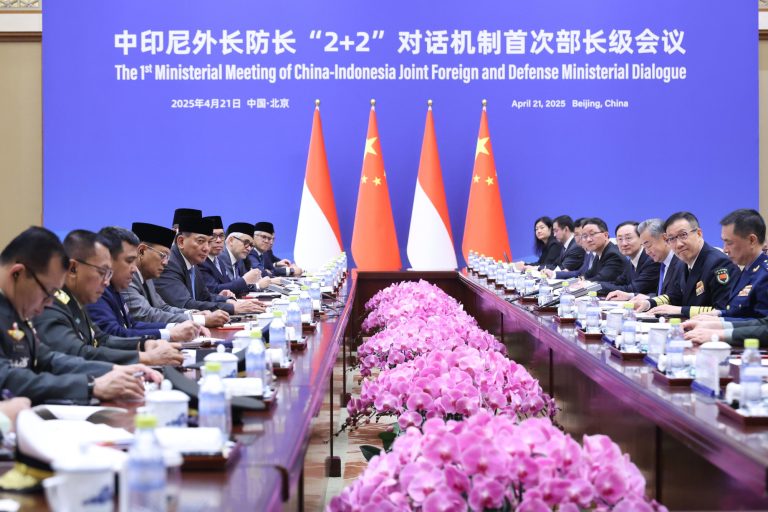
A Historic Elevation of Bilateral Ties
The symbolism of this dialogue speaks volumes. Beijing’s decision to select Indonesia as its first 2+2 ministerial partner signals Jakarta’s elevated importance within Southeast Asia and the Indo-Pacific region.
Chinese Foreign Minister Wang Yi emphasized this by describing the meeting as a reflection of “high strategic mutual trust” and positioning the relationship within a broader vision of a “community with a shared future.”
But beyond symbolism, this meeting also marked a concrete institutionalization of the bilateral partnership. The introduction of a formal, recurring 2+2 mechanism, along with the launch of a Comprehensive Strategic Dialogue Mechanism, establishes a structured platform for continuous high-level foreign policy and defense discussions. This ensures that the Comprehensive Strategic Partnership between the two countries is not just an aspirational framework but an operational reality, paving the way for faster and more coordinated decision-making on key regional and security matters.
Security & Defense: Strengthening Military Cooperation
The discussions resulted in tangible commitments, particularly in the areas of maritime security and defense collaboration:
✅ Maritime Security Cooperation – A new bilateral coast guard agreement strengthens security coordination at sea.
✅ Joint Military Exercises – Plans for joint military drills in 2025 indicate an increasing security alignment.
✅ Consultation Mechanisms – A dedicated framework on disarmament, non-proliferation, and arms control was introduced.
✅ Cybersecurity & Law Enforcement – Enhanced collaboration was pledged to address cyber threats and regional security challenges.
Additionally, discussions about Indonesia’s “Golden Indonesia 2045” vision and China’s modernization strategy suggest a long-term effort to align the two nations’ economic and security goals, reinforcing deep interdependence across multiple sectors.
Regional & Global Implications
The deepening ties between China and Indonesia will not only impact bilateral relations but also reshape dynamics within ASEAN, influence U.S. policy, and prompt strategic recalibrations in Australia:
🔹 Impact on ASEAN: While both nations champion ASEAN centrality, Indonesia’s growing alignment with Beijing could create new challenges. If Jakarta moves closer to China on sensitive issues, such as South China Sea negotiations, ASEAN’s unity could be tested. Other member states will closely monitor Jakarta’s role and may adjust their own diplomatic approaches.
🔹 U.S. Considerations: Washington views Indonesia as a key Indo-Pacific player in maritime security and regional stability. A stronger China-Indonesia security relationship complicates U.S. partnership-building efforts. The U.S. may need to reassess its engagement strategy with Indonesia to ensure continued diplomatic and security cooperation.
🔹 Australia’s Strategic Review: As Indonesia’s neighbor and long-time partner, Australia will closely track Jakarta’s defense ties with China. The announcement of joint military drills between China and Indonesia may prompt Australia to enhance transparency and dialogue with Jakarta to safeguard regional security interests.
Indonesia’s growing engagement with China also reflects a broader trend in Southeast Asia—many nations are deepening economic partnerships with Beijing while navigating complex geopolitical currents.
Final Reflections
The China-Indonesia 2+2 Dialogue represents a historic upgrade in bilateral relations, moving beyond diplomacy into institutionalized strategic cooperation. It strengthens security collaboration, aligns long-term national goals, and influences regional power dynamics within ASEAN and the Indo-Pacific. The ripple effects of this engagement will shape U.S., Australian, and ASEAN strategies, while also reinforcing Southeast Asia’s pursuit of multi-engagement diplomacy in an evolving global order.
✅ 2+2 Dialogue – A diplomatic format where foreign ministers and defense ministers from two nations meet together, fostering high-level cooperation on security and foreign policy.
✅ Comprehensive Strategic Partnership – A formal diplomatic agreement signifying deep collaboration between two countries in multiple sectors, including politics, security, and trade.
✅ ASEAN Centrality – The principle that ASEAN (Association of Southeast Asian Nations) should lead and shape regional policies and diplomacy, rather than being influenced by outside powers.
✅ Non-Proliferation & Arms Control – International efforts to limit the spread of weapons, particularly nuclear, chemical, and biological arms, ensuring global security.
✅ Golden Indonesia 2045 – Indonesia’s long-term national vision aiming for economic growth, technological development, and regional leadership by the year 2045.
Jargon Definations
 NightingaleSea
Leave a comment